Institutions Have Arrived On Solana

The Institutions Have Arrived On Solana
Solana Just had Its Best year
2025 became the year global finance began building on Solana’s rails.
Payment giants led the way: Stripe’s global merchant network, Worldpay with $2.5T in annual volume, Shift4 powering 1/3 of U.S. restaurants and two-fifths of hotels, and a growing list of major apps integrated Solana for stablecoin settlement.
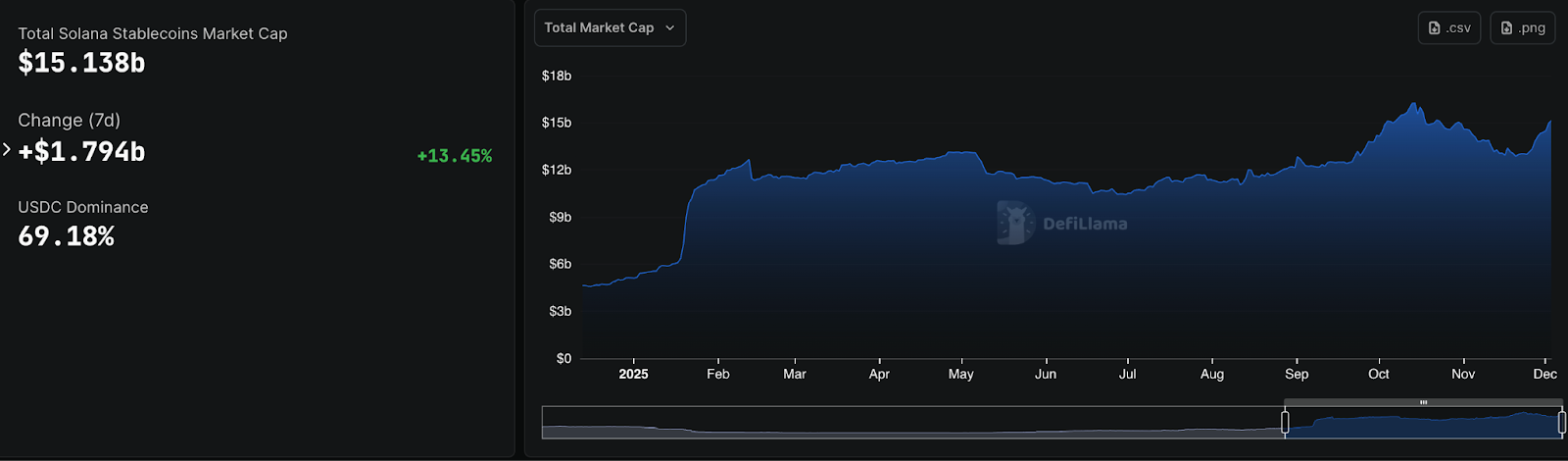
Stablecoin activity surged in parallel. Solana’s stablecoin market cap expanded from $5.10B at the start of the year to $15.13B today, a ~197% increase driven by real transaction velocity.
Then institutions arrived. Major issuers, including BlackRock, Apollo, Paxos, and Ondo, launched tokenised products on Solana. Distributed Asset Value rose from $173M to $771M, a 344% surge as RWAs and tokenised funds scaled directly on-chain.
This article follows that arc: how payment networks adopted Solana, why stablecoin velocity concentrated there, why institutions are choosing Solana for tokenized securities, and how Internet Capital Markets infrastructure positioned Solana as a settlement layer.
Let's start with payments, where the institutional wave began.
Payment Infrastructure: The TradFi Integration Wave
Solana's payments ecosystem accelerated sharply through 2025, driven by major product launches, fintech integrations, and stablecoin-native payment activity. Payments have become a high-volume production environment where chains must prove speed, reliability, and predictable fees. Solana is one of the few networks already demonstrating that behaviour.
3 core developments from November 2025 happened in Solana payments:
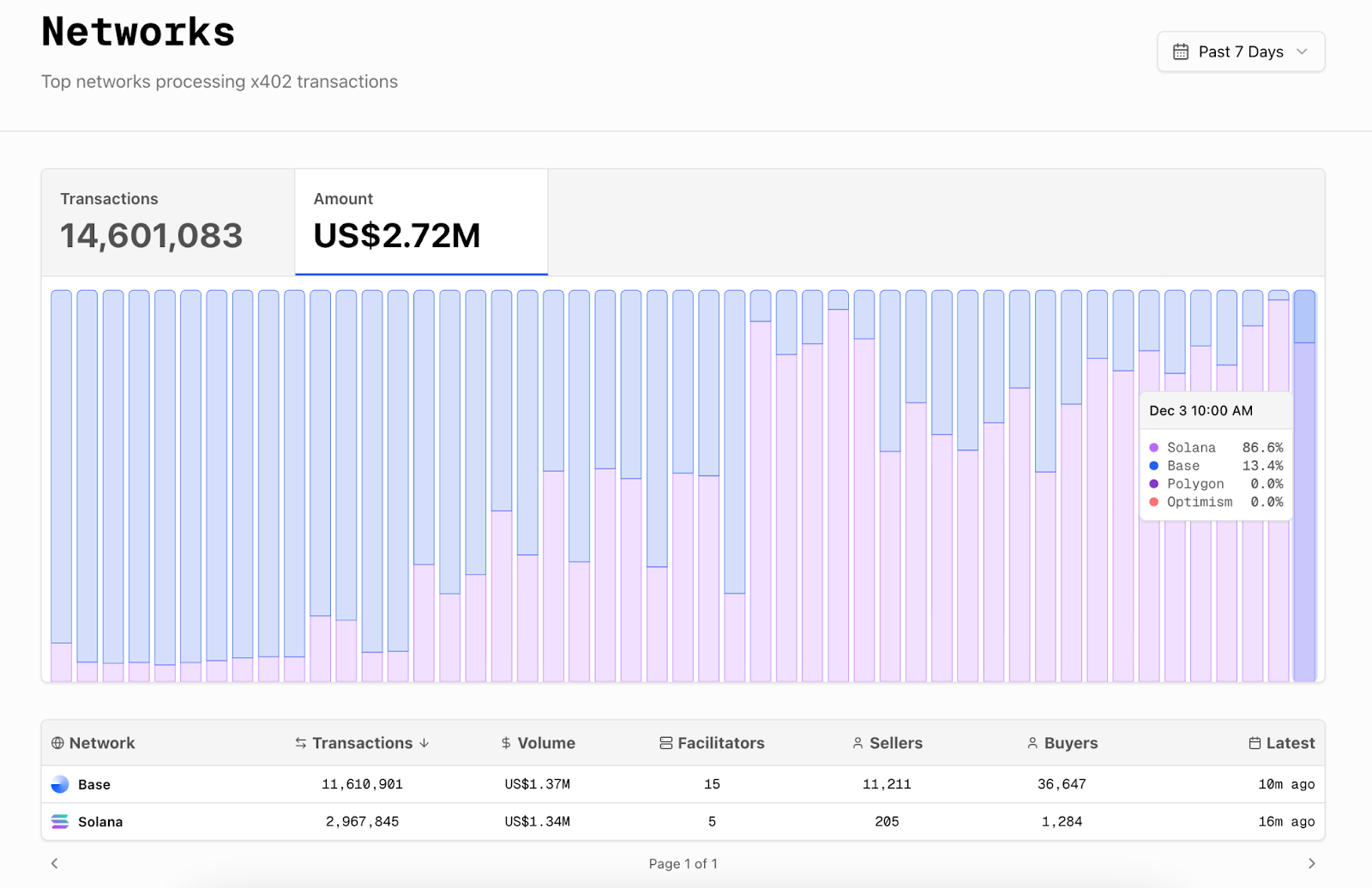
- X402 (an AI-native payment network) surged this week with Solana becoming the #1 network. Volumes rose 750% WoW, Solana flipped to lead in dollar volume, and hit an ATH $380K processed on 30 Nov.
- Western Union (100M customers, hundreds of billions annually) launching USDPT stablecoin on Solana in H1 2026
- Cash App is bringing USDC payments to 57M monthly users in 2026
Who's Building Payment Infrastructure on Solana
The ecosystem extends across multiple payment categories:
- Merchant Processing: Stripe, Worldpay, Fiserv, Shift4, PayPal, MoonPay
- Cross-Border: Western Union, Sphere, CFX Labs (MoveUSD), Circle CCTP V2
- Consumer Banking: Cash App, Phantom CASH, Fuse, Teleport
- Debit Cards: KAST, Solayer Card, Sanctum Cloud Card, Solflare Card
With this breadth of activity, the natural question appears: “Why are so many global processors choosing Solana?”
The clearest answer comes from the company that made the largest move of all.
Case Study: Stripe & Solana Integration
In February 2025, Stripe acquired Bridge (stablecoin infrastructure provider) for $1.1 billion, its largest acquisition ever, because Stripe recognised stablecoins as the future of global payments.
After abandoning Bitcoin in 2018 due to speed and cost issues, Stripe returned to crypto when stablecoins solved those problems. In the first week of offering stablecoin checkout, Stripe processed more stablecoin volume than all its Bitcoin volume ever.
The Problem: Stripe processes $1.4 trillion annually, but global cross-border payments ($120 trillion market) remain slow through traditional rails. International wires take 2-7 days with high FX fees and bank intermediaries.
Why Solana: Bridge, now Stripe's stablecoin engine, supports Solana as a core settlement rail. Solana offers the lowest fees and fastest settlement among all chains. For millions of daily payments requiring 400ms finality and <$0.01 costs, Solana's architecture matches requirements.
What Stripe Has Built: Through Stablecoin Financial Accounts, businesses gain the ability to:
- Receive money: Deposit USDC from Solana wallets directly into Stripe accounts
- Hold balances: Treat Solana USDC like USD bank balances
- Send payouts: Withdraw USDC to Solana wallets or banks globally (e.g., US company paying Philippines contractor settles instantly via USDC)
- Issue cards: Stablecoin-backed debit cards where Solana USDC converts at point-of-sale
Other Major Payment Integrations
Stripe may have been the loudest signal, but it wasn’t the only one. Here is just a little about a few of the most notable payment apps building on Solana:
- Worldpay processes $2.2 trillion annually. Rather than merely adding an API, they integrated Solana deeply, settling in USDC and USDG, and even running validator nodes.
- Fiserv connects 10,000 financial institutions and 6 million merchants, processing 90 billion transactions a year. They’re launching FIUSD, their fiat-backed stablecoin, natively on Solana. Once live, millions of merchants gain settlement over Solana rails through their existing Fiserv relationships.
- Shift4 processes $260 billion annually and powers one-third of U.S. restaurants and 40% of hotels. They rolled out SOL, USDC, and USDT payments in late 2024, letting customers pay in crypto while merchants receive USD, where Shift4 handles the conversion through Solana settlement.
Why Payment Processors Choose Solana
Payment infrastructure demands three things: speed, predictable costs, and scale. Solana delivers all three.
Transactions finalize in 400 milliseconds, faster than a credit card swipe, at a flat $0.001 fee regardless of network load. For processors like Fiserv handling 90 billion transactions annually, predictable unit economics aren't optional, they're essential for margin calculations.
Unlike EVM chains that process transactions sequentially, Solana's parallel execution can handle thousands of transactions simultaneously. Scaling works linearly: double the volume, double the cost, not exponentially more. In January 2025, Solana processed more than 1/10th of Nasdaq's daily volume without disruption. No other public blockchain has demonstrated that capacity in production.
Token Extensions add payment-grade compliance out of the box. Confidential Transfers keep amounts private while remaining visible to regulators. Transfer Hooks trigger automatic compliance checks on every transaction. Permanent Delegate enables clawbacks when law enforcement requires it. Processors get institutional-grade infrastructure without writing custom smart contracts.
Stablecoins: Internet-Native Payment Infrastructure
Payment rails need something to move through them. And that meant stablecoins.
Stablecoins link fiat stability with blockchain benefits, becoming the backbone for internet-native payments.
The trajectory is clear: in less than 5 years, stablecoin volume reached 46% of ACH volumes ($3.4T vs $7.3T). Visa, Mastercard, and PayPal adopted stablecoins for speed and cost advantages that traditional rails can't match. But not all stablecoin activity is equal. Some chains store capital, others move it.
Solana Stablecoin growth
Solana's stablecoin supply started 2025 at $5.10 billion. By December, it reached $15.13 billion, a 197% increase driven by real transaction velocity, not memecoins speculation.
Growth accelerated in January. The TRUMP memecoin launch triggered $270 million in stablecoin inflows, followed by $1.75 billion two days later. Within a month, supply doubled from $5.2 billion to $11.7 billion.
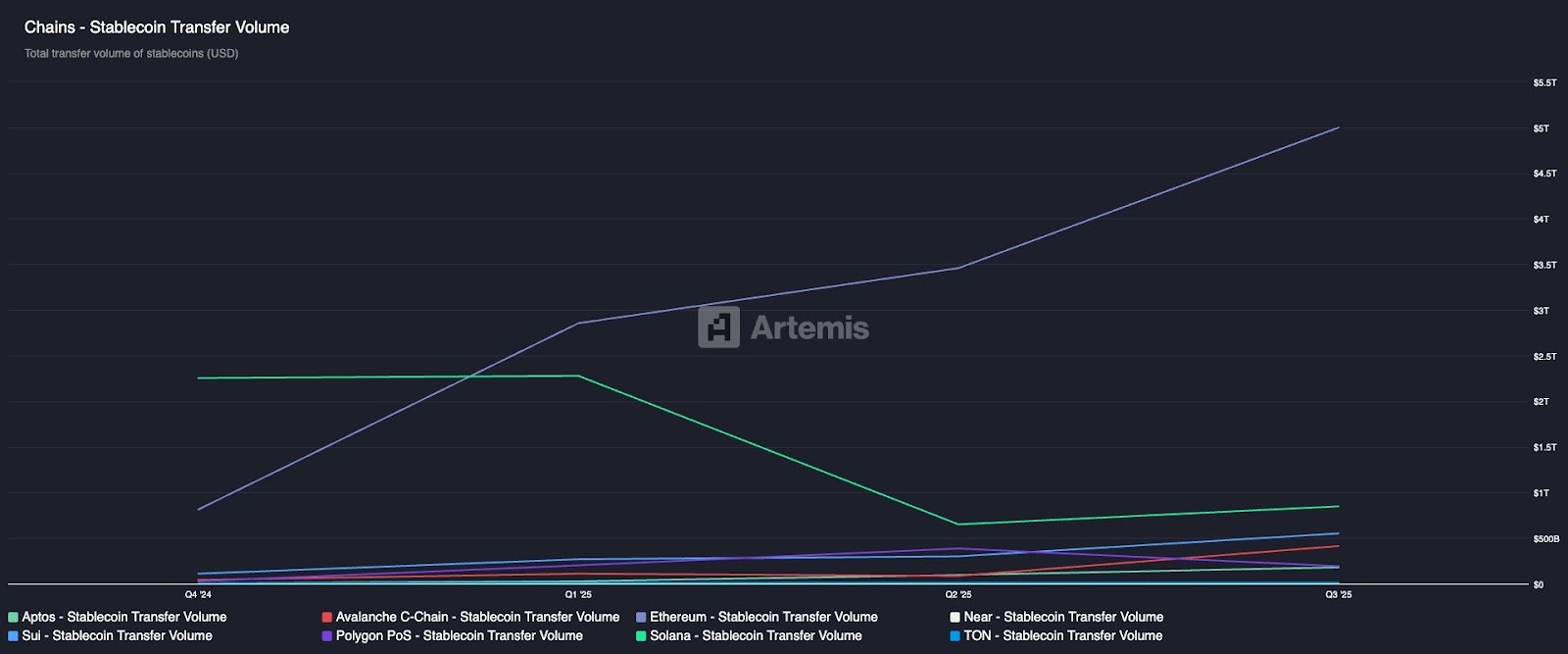
The momentum continued throughout the year. In Q1 alone, Solana processed $2.3 trillion in stablecoin transfer volume, 79% of Ethereum's $2.9 trillion, demonstrating the network's capacity for high-velocity settlement. Solana maintained its #2 ranking in stablecoin transfer volume across all three quarters of 2025, processing institutional-scale flows with sub-second finality and near-zero fees.
Global Transaction Count
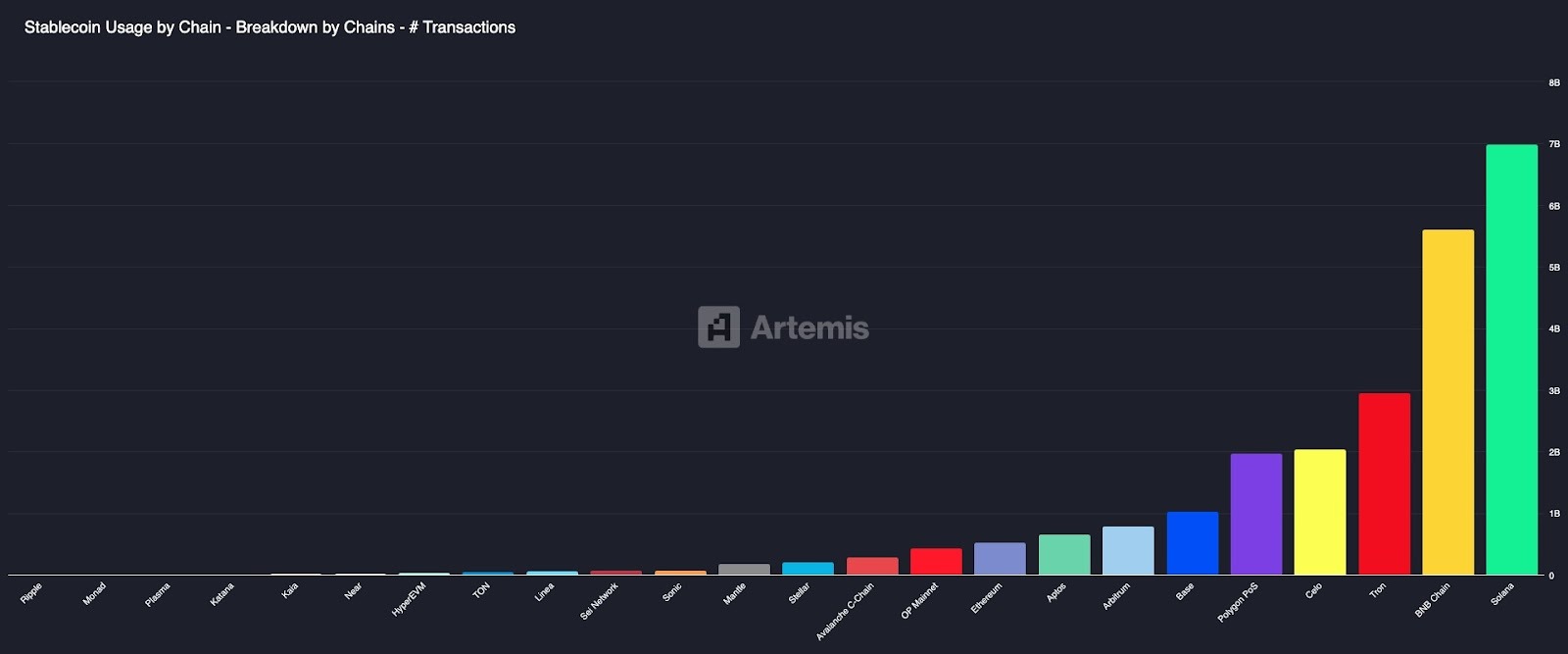
Transfer volume shows where big money moves. Transaction count shows where real activity happens, including remittances, merchant settlements, cross-border payments, and everyday use.
Solana processed 7 billion stablecoin transactions in 2025, more than any other blockchain. BNB Chain followed at 5.6 billion, Tron at 3 billion, Celo at 2 billion, and Polygon PoS at 1.9 billion. That's 25% more than the second-place network, outpacing chains with far larger retail user bases.
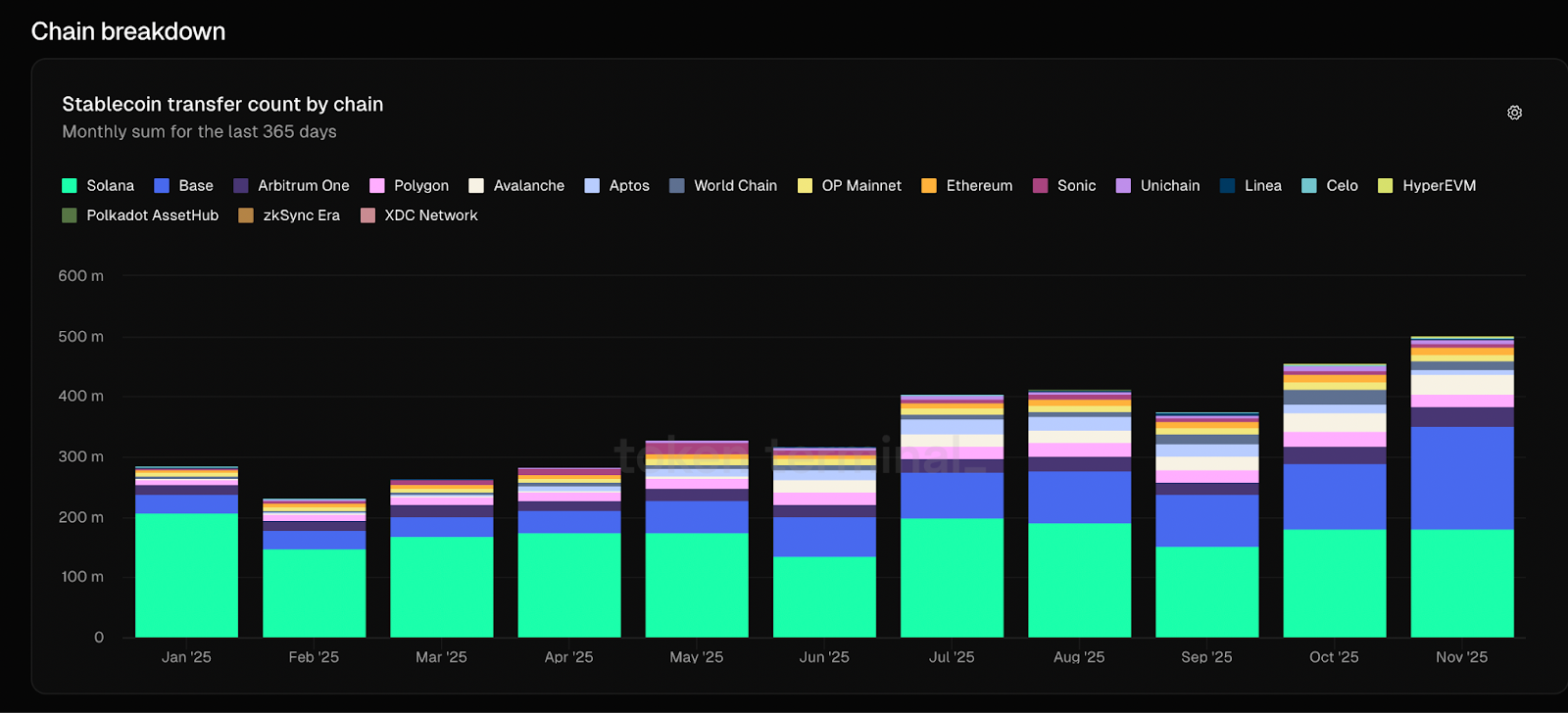
For USDC specifically, the dominance is even clearer. USDC comprises 70% of Solana's stablecoins ($10.52 billion). This matters because USDC is built for institutional payments with Circle's regulatory compliance and banking infrastructure.
Solana dominated USDC transfer activity every quarter: 522.8M in Q1, 483.3M in Q2, and 543.4M in Q3, far ahead of Base (247.3M peak) and Ethereum (29.6M peak). By mid-2025, Solana processed nearly 50% of all USDC transfers globally, consistently handling 5-30x more transfers than other major chains.
Solana supports Circle's CCTP V2 integration, which enables native burn-and-mint transfers of USDC without wrapped assets or bridge risk. It plugs Solana directly into a global USDC network across major chains and lets apps trigger on-chain actions when funds arrive. CCTP v2 also standardizes cross-chain messaging, giving Solana access to unified USDC liquidity and atomic flows into DeFi, wallets, and payment rails.
The Stablecoin Ecosystem
USDC dominance tells you what's moving. But Solana's stablecoin ecosystem extends far beyond a single asset. The network hosts purpose-built stablecoins across payment settlement, cross-border transfers, DeFi liquidity, and institutional capital:
The institutional side reveals a two-wave pattern.
Wave One: Payment Stablecoins
USDC from Circle. PYUSD from PayPal. USDG from Paxos. These became the settlement layer for Stripe, Worldpay, Fiserv, and Shift4, moving trillions annually. Payment infrastructure proved that Solana could handle enterprise scale.
USDC grew from $3.5B to $10.5B in 2025, which is a 200% increase driven by Stripe, Worldpay, and Fiserv integrations. Circle's CCTP V2 with native Solana support eliminated the risks of bridging entirely.
PYUSD (PayPal) grew 447% from $189M to $1.03B. PayPal chose Solana specifically for Token Extensions, Permanent Delegate for compliance, and Transfer Hooks for automated logic. When PayPal needed programmable payments at scale, they built it on Solana.
USDT holds $2B on Solana, up 132% since January. While USDC powers institutional payments, USDT serves as the DeFi liquidity rail: trading pairs, CEX bridging, remittance corridors.
Wave Two: RWA and Asset Tokenisation
Then the world's largest asset managers arrived. BlackRock launched BUIDL. Apollo launched ACRED. Ondo launched USDY. Payments were the entry point. Tokenized finance is what followed.
BUIDL: BlackRock's Tokenised Money Market Fund on Solana
BlackRock, the world's largest asset manager with over $13 trillion in AUM, launched BUIDL on Solana in March 2025, marking a major institutional validation of the network. BUIDL is a tokenized money market fund investing in cash, US Treasury bills, and repurchase agreements.
Explosive Growth on Solana
BUIDL's growth on Solana demonstrates rapid institutional adoption:
- March 24, 2025: $20 million deployed on Solana
- December 2, 2025: $254.7 million deployed on Solana
- Growth: 1,173% increase in just 8 months
Why BlackRock Chose Solana
Securitize CEO Carlos Domingo called Solana expansion a "natural next step" as demand for tokenized real-world assets rises. Solana Foundation President Lily Liu highlighted the network's speed, low costs, and developer activity as ideal for tokenized assets.
The 1,173% growth from $20M to $254.7M on Solana in just 8 months demonstrates institutional confidence in the network's reliability for managing hundreds of millions in tokenized assets. BlackRock's deployment validates Solana as an institutional-grade settlement infrastructure system for regulated securities, not just payments.
ACRED: Apollo's Tokenized Private Credit Fund
Apollo Global Management, one of the world's largest alternative asset managers with $733 billion AUM, launched ACRED on Solana in January 2025 in partnership with Securitize. ACRED (Apollo Diversified Credit Securitize Fund) provides tokenized access to Apollo Diversified Credit Fund, typically reserved for institutional investors with $10M+ minimums.
Growth on Solana:
- March 20, 2025: $24.76M
- December 1, 2025: $32.03M
- Growth: 29.4% increase in 8 months
ACRED invests across corporate direct lending, asset-backed lending, and structured credit, alternative strategies normally inaccessible to most investors. Tokenization on Solana enables daily NAV redemptions, 24/7 settlement, and transparent on-chain records versus traditional quarterly redemptions and paper-based processes.
When Apollo tokenizes private credit on Solana alongside BlackRock's BUIDL, it validates the network for complex alternative investment strategies, not just payments and Treasuries.
The Bigger Picture: Internet Capital Markets
Throughout this article, we've traced a clear progression:
- Payment giants like Stripe, Worldpay, and PayPal chose Solana for stablecoin settlement.
- Stablecoin supply responded, nearly tripling to $15.13B as transaction velocity concentrated on the network.
- Then the world's largest asset managers, BlackRock, Apollo, Ondo, began tokenizing securities directly on-chain.
All of these pieces, payments, stablecoins, and institutional adoption are interconnected components of a larger vision: Internet Capital Markets.
What Are Internet Capital Markets?
Internet Capital Markets represent Solana's vision to rebuild traditional capital markets on blockchain rails. The concept is transformative: securities issuance, trading, settlement, compliance, and corporate actions, all operating on a single, programmable layer accessible globally.
Solana is purpose-built to become "Nasdaq on-chain." Here's what this means for institutions:
How ICM Infrastructure helps RWA Issuers
Traditional securities infrastructure relies on layers of custodians, transfer agents, and off-chain recordkeeping. 46% of corporate event data is still processed entirely manually, with costs rising 33% by 2027. Solana collapses this into programmable, real-time settlement.
Programmable compliance. Token Extensions enforce lockups, jurisdictional filters, and accreditation checks at the protocol level, not through manual review. Securitize uses this for BUIDL and ACRED, automating Transfer Agent functions with immediate settlement.
Automated corporate actions. Dividends, splits, voting, and M&A events, which would traditionally require multiple intermediaries, now execute through smart contracts. Deterministic, transparent, instant.
24/7 settlement. ACRED enables daily NAV redemptions versus traditional quarterly windows. BUIDL investors access Treasury yields with instant on-chain settlement rather than T+1 or T+2 delays.
Transparent audit trails. Every transfer, freeze, and policy change is recorded immutably. Regulators verify transaction history on demand without requesting records from multiple intermediaries.
DeFi composability. Tokenized securities can serve as collateral in lending protocols or participate in whitelisted liquidity pools, a level of capital efficiency which is impossible in traditional markets.
Why Solana Over Alternatives?
Unified vs. Fragmented. EVM chains rely on Layer 2 solutions that fragment liquidity across ecosystems. Solana enables unified capital markets: orders, asset flows, and regulatory checks on a single execution layer. No bridging risk, no liquidity fragmentation, no multi-chain complexity.
Built-in compliance. Token Extensions provide institutional controls natively: Transfer Hooks for KYC/jurisdiction enforcement, Permanent Delegate for clawbacks, Confidential Balances for privacy with auditor visibility, and Default Account State for permissioned access. No custom smart contracts required.
Proven scale. 100% uptime over 22 months. $35.9 billion ATH daily DEX volume. More than 1/10th of Nasdaq's volume processed without disruption.
Conclusion: Is Solana Building an Institutional Settlement Layer?
Yes, and the infrastructure is already in production. The combination of native compliance controls, sub-second settlement, and institutional-grade tooling positions Solana as a credible platform for tokenized securities at scale.
As regulatory frameworks mature and more issuers evaluate blockchain infrastructure, the networks that can deliver both performance and programmability without custom development overhead will capture market share. Solana has demonstrated it can handle institutional volume, support complex compliance requirements, and maintain composability with DeFi.
The foundation is built. The question now is adoption velocity.